
Most distributors can tell you how their business is performing at a high level:
- Revenue trends
- Order counts
- Quota progress
What’s harder to see is what’s driving those numbers. Which orders are profitable. Which customers are putting pressure on margin. Which day-to-day decisions are affecting outcomes long before they show up in a report.
That gap is where margin starts to slip away. Most leaders are constrained by what their systems make it easy to see. Revenue, order counts, and quota progress are visible because they’re automatically summarized in ERP systems. Profit drivers, cost-to-serve, and order-level decisions are harder to surface, so they’re pushed downstream. Over time, attention follows visibility, not importance.
At lower volumes, running on instinct works. Leaders are close to the work, exceptions stand out, and patterns are easy to spot. As complexity grows, however, that same instinct becomes harder to rely on – not because leaders change, but because the business does.
The 5 Points in Your Operation Where Profit is Decided
Margins are thin, labor is tight, and customers have more choices. In this environment, small decisions quickly compound. When leaders rely on high-level metrics alone, they miss insight and manage too late. Profit is given up order by order, decision by decision, long before it shows up in the financials.
Profit is decided in five places inside your operation:
1. At the Order Level: Where Margin is Created or Destroyed
Margins don’t disappear randomly—they leak out through orders, products, and processes that quietly underperform. This session shows how Profit isn’t created at the month-end summary. It’s created or destroyed inside individual orders. Every pricing decision, freight charge, override, and service touch leaves a data trail.
But without visibility, most leaders don’t know which orders are losing money, where margin is leaking, or what levers they can manage. Not because they don’t care, but because they’re busy fighting fires and their systems were never designed to surface profitability at that level.
For many distributors, 35%-40% of orders contain profit defects: underpriced items, missed freight recovery, unnecessary credits, or pricing drift. Multiply that across thousands of transactions and it’s easy to see why some distribution businesses struggle to break out of single-digit margins. When profit decisions happen across thousands of orders, no amount of experience can track them manually at scale.
Many distributors are aware that margin leakage exists. Far fewer can see it while it’s happening. Awareness at the order level creates clarity, and visibility creates control.
How Cavallo helps
Most ERPs – a system of record – summarize profit after the fact. Cavallo surfaces it while the order is still in motion. By treating the order as the atomic unit of value, Cavallo helps distributors:
- See profit per order
- Identify where margin is leaking (e.g., freight, overrides, pricing drift)
- Track and resolve exceptions before they compound

The result is going beyond reporting to control.
2. In How You Allocate Focus: Which Customers and Products Pay Off
The customers and products that look strongest in aggregate often tell a different story once cost-to-serve and margin volatility are considered.
A high-volume SKU isn’t necessarily profitable once you factor in supplier cost increases, returns, small order sizes, or labor-intensive handling. The same is true for customers. Some of the biggest accounts lose their shine once cost-to-serve is considered.
In one distributor’s data set, a single SKU saw 5,000 transactions where costs increased but prices didn’t over a 12-month period. That’s margin leakage hiding in plain sight.
The priority shouldn’t be who buys the most, but who contributes the most profit. Similarly, product success should be measured by what drives the most to the bottom line.
When profitability isn’t visible, focus follows volume. Sales attention, service levels, and pricing flexibility flow to the biggest accounts even when those accounts contribute the least. Meanwhile, high-margin customers and products are under-supported, simply because they’re harder to see.
How Cavallo helps
Cavallo helps distributors make segmentation operational. By scoring customers and products based on profitability, leaders can:
- Reclassify customers using contribution, not volume
- Identify SKU-level margin volatility
This is about focus: putting attention where profit is actually driven.
3. In Customer Behavior Shifts: Before Revenue Disappears
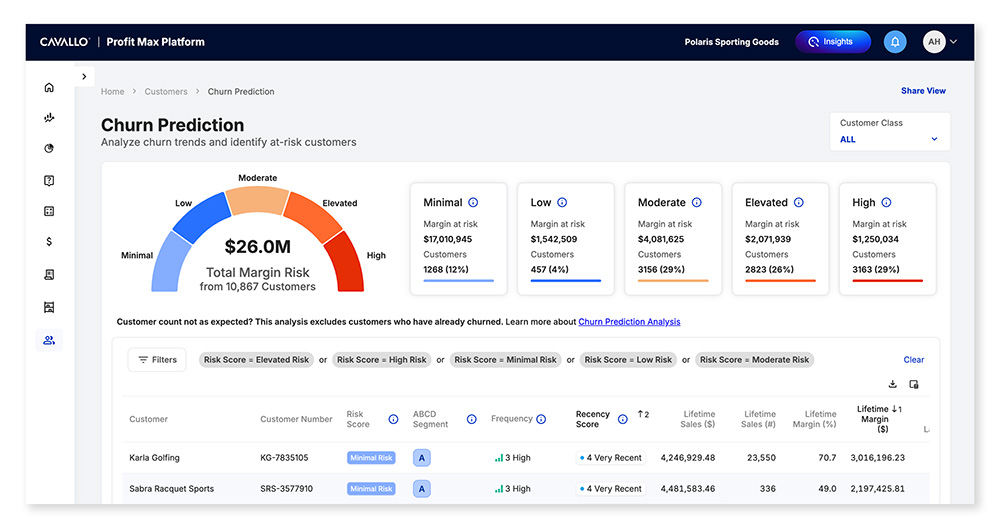
Customer loss rarely shows up as a sudden stop. It shows up gradually in the form of fewer orders, smaller baskets, and subtle shifts in product mix.
The data exists to uncover warning signs: order frequency, average order size, and recency of purchase. The difference is whether a distributor can translate that into action. Protecting profitability starts long before a customer walks out the door.
Losing a low-margin customer hurts revenue. Losing a high-margin customer changes the economics of the business.
How Cavallo helps
By combining order history, buying patterns, and AI-assisted analysis, Cavallo helps distributors:
- Assign dynamic risk scores to customers
- Detect early signs of customer turnover
- Trigger proactive outreach before revenue disappears
Retention stops being reactive and becomes intentional.
4. At the Point of Sale: Where Profit is Negotiated
When margin visibility isn’t available in real time, discounting becomes reactive and overrides become routine. Pricing guardrails either reinforce discipline—or allow margin erosion.
Sales execution is one of the most underappreciated profit levers in distribution. Without real-time margin visibility, reps are forced to choose between speed and confidence. Most choose speed and hope the margin holds.
But when compensation and visibility align to profitability, sales behavior changes. Reps stop firefighting and start managing the levers inside each order.
How Cavallo helps
Cavallo brings profitability into the sales workflow, which is where decisions are made.
Sales teams gain:
- Real-time margin visibility during quoting
- Guardrails that reinforce pricing discipline
- Insight into how discounts and overrides affect profit
The goal is informed execution throughout the order process.
5. Across the Order Lifecycle: Where Process Impacts Profit and Cash
For many distributors, order management lacks transparency. Leaders don’t see what’s happening until weeks later, if at all. Manual touches delay invoicing, increase errors, and hide cost-to-serve. Every rekeyed order and workaround leaves a trail that affects both profit and cash flow.
How Cavallo helps
Cavallo surfaces the order lifecycle end to end. Distributors can:
- Track orders as they move through the business
- Identify friction points and rework
- Reduce manual steps that slow cash and erode margin
Process visibility creates financial flexibility.
Signs Profit is Being Managed Too Late
If these patterns feel familiar, it’s a sign that you’re focused more on tracking orders and activity, and not where profit is being made or lost.
- Month-end results feel surprising, even when sales “look good.”
- Margin discussions start after books close.
- Teams spend more time explaining numbers than acting on them.
- The same pricing, freight, or discounting issues keep reappearing.
- Profit lags sales growth.
- Fixes are reactive: credits, overrides, and reconciliations.
- Order-level profitability cannot be identified week to week.
This isn’t about effort; it’s about whether profit is visible and managed at the level where it’s actually created.
What Happens When Visibility Replaces Assumption
When profitability is visible, profit discipline becomes embedded in how the business operates. Cavallo enables this by bringing margin visibility and guardrails into the workflows where decisions are made.
Instead of discovering issues after the fact, teams can see margin drivers at the order, customer, and product level; address defects before they compound; and put insight into the hands of people making day-to-day decisions.
Experience still matters. But in high-volume, high-variability environments, experience alone doesn’t scale. The shift from gut feel to the right tools allows leaders to manage complexity without losing control.