
SalesPad for BC
AI-Powered Customer Insights for Distribution
Distribution teams already have customer data. The challenge is knowing what to do with it while orders are still moving, margin decisions are still being made, and customer relationships can still be saved.
SalesPad for BC helps product-centric businesses turn ERP and order data into daily profit action. With Customer IQ for BC, teams can use AI customer insights to spot account risk, protect margin, and route sales documents through tailored approval and prioritization workflows (requires SalesPad Mission Control).
For distributors running on Microsoft Dynamics 365 Business Central, that means customer intelligence does not have to sit in a report that someone reviews later. SalesPad for BC connects customer signals to margin protection, retention, and order workflow decisions.
Account health and churn risk
What are AI customer insights?
AI customer insights are patterns, signals, and recommended actions created by analyzing customer data with artificial intelligence. In distribution, those insights should go beyond marketing trends. They should help teams understand account health, order behavior, buying frequency, margin contribution, and churn risk.
Raw data tells you what happened. A report might show lower order volume, a lower-margin purchase, or a missing high-value item. Actionable insights tell your team what needs attention and why. That matters during order entry, pricing review, and margin planning.
AI can also analyze purchasing behavior across order cadence, transaction frequency, monetary spend, and ERP buying patterns. Predictive risk signals can help teams see attrition probability, purchasing lulls, or engagement shifts sooner. For distributors, this is most useful when behavioral data is paired with order history, margin contribution, customer value, and workflow activity.
uniting fragmented data
Why customer insights stall in distribution
Most distributors do not struggle because they lack data. They struggle because data lives in too many places. ERP transaction tables, sales quotes, posted invoices, and customer ledger records often reveal isolated fragments of the customer relationship.
When teams connect those dots by hand, insight becomes slow and uneven. Sales may know an account has gone quiet, but finance may see margin erosion first. Operations may notice buying lulls before leadership sees the account risk.
AI-driven customer insights unite these transaction patterns into actionable context, surfacing predictive churn risk and profitability segments right where daily work happens. The goal is not passive analysis, but rapid, profitable decisions that protect vital accounts and reduce preventable churn.

Keep every relationship on track
How customer insights drive profit performance
Profitability in distribution is often lost in small moments. Pricing no longer reflects cost. A sales rep misses a change in order frequency. A low-margin order moves through the system without review. A high-value account shows early churn signals.
AI-powered customer insights and margin intelligence detect revenue leaks before small issues become larger financial problems. For distributors, that visibility catches low-margin order lines, customers drifting away from profitable buying patterns, discounting that violates margin thresholds, and unapproved pricing exceptions.
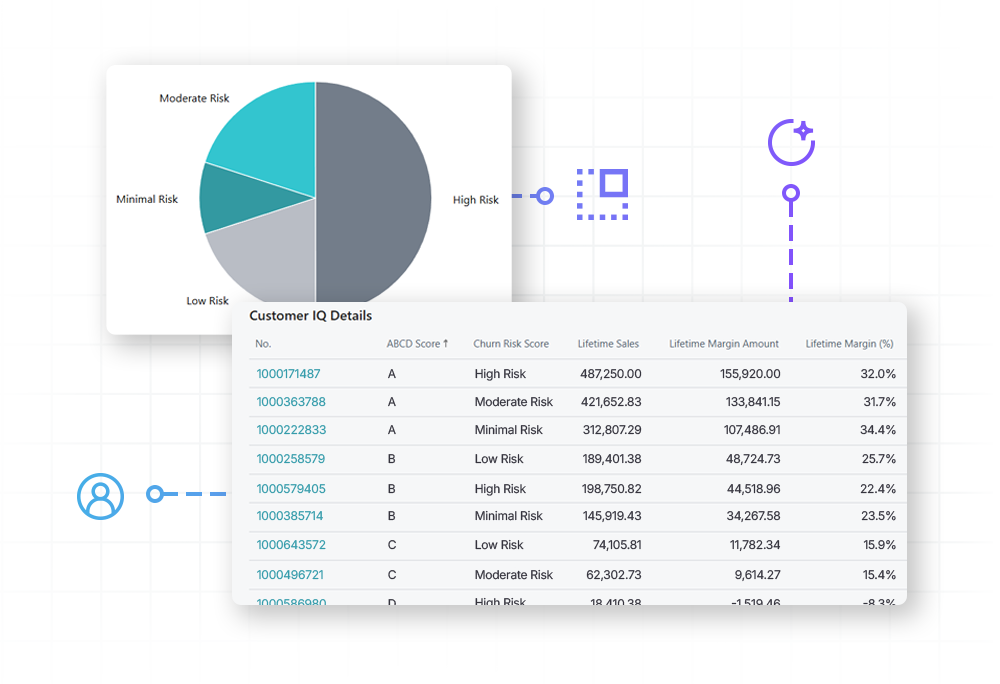
Customer IQ’s predictive analytics compare historical buying patterns, transaction frequency, order cadence, and margin contribution to flag accounts that need attention. Those signals help sales leaders prioritize outreach and finance teams see where profitability is gained or lost.
SalesPad for BC keeps the focus on profit action. Instead of treating intelligence as a separate analytics task, embedded order and customer insights help teams see what to review, what to correct, who to contact, and which customers deserve the next move.
embedded in every order
AI-powered customer workflows and order intelligence
Customer intelligence becomes more valuable when it reaches the point of work. A sales rep should not have to leave an order screen to learn that an account is at risk. A manager should not have to wait for a month-end review to see margin erosion. A customer service team should not have to guess which account needs a faster response.
With the right workflow design, AI-driven customer insights can guide order entry, pricing review, account follow-up, and fulfillment decisions. Predictive churn alerts highlight accounts when buying frequency drops. A margin risk signal can flag an order line before release. A churn score can help sales managers focus outreach.
This is where SalesPad for BC fits as an order intelligence partner. SalesPad for BC extends Business Central with workflow automation, real-time margin protection, and order visibility for distributors. When customer insights connect to those workflows, teams can protect profitability without adding another disconnected tool.

Core capabilities
AI tools for actionable customer insights
The best AI tools for actionable customer insights should do more than summarize customer data. They should connect to the systems that run the business, explain what changed, and give teams a practical way to act.
Customer value and churn risk
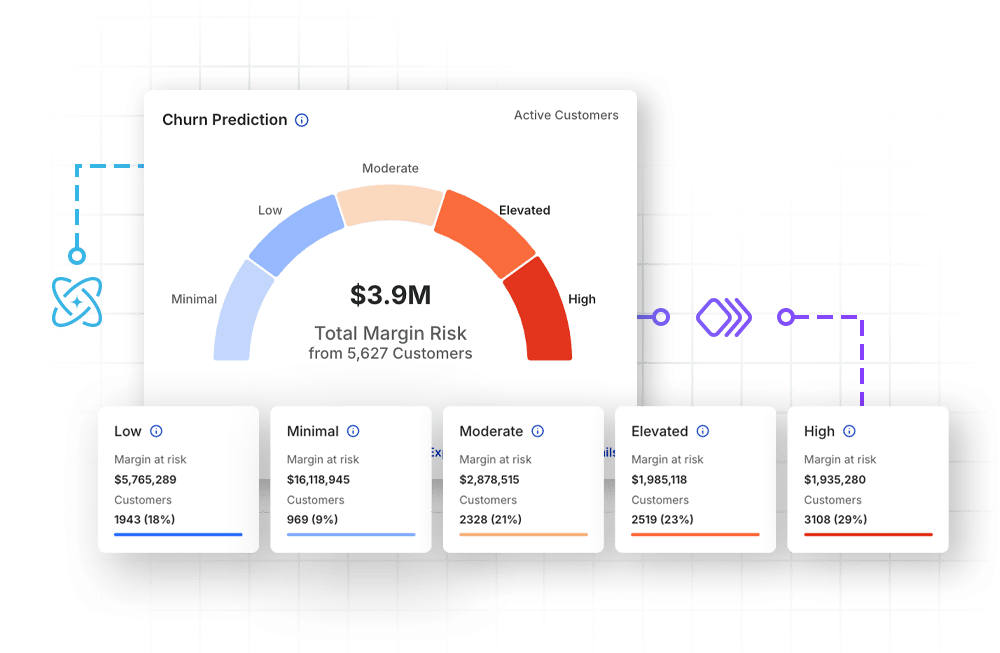
Customer IQ helps teams identify which accounts contribute the most value and which may be at risk of leaving. Predictive churn signals and customer segmentation help sales teams prioritize accounts that need attention and respond to changes in buying behavior sooner.
Real-time alerts for margin risk
Real-time alerts help users act while an order is still open. Profit Scan flags line items with unusual discounting or unreflected cost changes, while Customer IQ surfaces buying patterns that signal elevated churn risk. Integrated into Business Central, these targeted alerts empower teams to intervene immediately without digging through several reports.
Automated rules and human review
Automated rules in Mission Control can help move insight into action by flagging accounts or orders that need attention. Teams can route an order for pricing approval, hold a risky order for review, or trigger other workflow actions based on Customer IQ health, churn risk, or Profit Scan margin data.
For higher-risk orders, Mission Control business rules automatically flag, hold, or route the order for review before it moves forward. That gives sales, operations, or finance a chance to check pricing, margin, customer status, or fulfillment details before a small issue becomes a larger profit problem.
AI-driven insights
Turning data into action

AI-driven customer insights become more useful when they pull customer, order, and ERP data into one view. In distribution, that may mean connecting sales history, posted invoices, pricing, and buying cadence so teams are not making decisions from disconnected reports.
Once the data is connected, predictive analytics can help identify churn risk and other customer behavior shifts before they show up as lost revenue. The machine learning model flags accounts with slowing purchase frequencies, declining order values, or shrinking margin contributions.
The output is a clear, prioritized view of actionable customer insights. Instead of leaving users with hundreds of unranked accounts, the system surfaces which accounts, orders, products, and margin signals need attention first, empowering teams to intervene proactively.
Coordinate the next move
AI-derived customer insights for sales and operations
Sales and operations teams use customer data in different ways, but they need the same shared view of account health. Sales wants to know where to focus outreach and which at-risk accounts require immediate retention efforts. Operations wants to know which orders need attention, which customers require special handling, and where fulfillment delays or margin exceptions may disrupt delivery.
AI-driven customer insights surface those priorities directly within the customer cards, order screens, and workflow dashboards teams already use every day. A sales representative sees predictive churn risk and profitability grades before contacting a buyer. A customer service rep immediately identifies margin-eroding discounts or unapproved pricing exceptions at order entry. An operations manager sees which sales lines fall below margin targets and where automated workflow holds prevent non-compliant orders from advancing.
That shared view helps the business move as one team. Instead of waiting for disconnected, retrospective reports, users make profitable, informed decisions throughout the order-to-cash cycle.

Create an adoption path
Implementing AI for customer insights in your ERP stack
A practical rollout should start by mapping the data sources that support one focused use case. For many distributors, margin recovery is a strong starting point because the data is often available in sales orders, item cards, customer records, posted invoices, sales price lists, and unit costs. Churn risk and account segmentation can follow as teams validate historical transaction data and define how users should respond.
The integration approach matters. Real-time integration can support order entry alerts and automated workflow holds during order entry, while automated background syncs periodically recalculate predictive account scores and customer segmentation. This ensures order takers receive instant guardrails while leadership maintains refreshed behavioral metrics.
A pilot can focus on high-volume SKUs, high-value customers, or a business unit where margin pressure is easy to measure. Keep the scope tight, define the response process, and make sure users know what to do when the insight appears.
Measuring ROI
Actionable AI insights
AI should be measured by the business action it supports. For customer insights, that means looking beyond passive scoring and tracking what changed after a user acted.
Useful metrics may include recovered margin per order, pricing corrections, account outreach completion, order-to-cash cycle time, customer retention, and reduction in manual report work. Finance stakeholders may also track how proactive account prioritization and margin intervention created measurable profit impact. This makes ROI easier to discuss. The key question is how the business used a behavioral pattern to protect margin, retain an account, improve a workflow, or reduce avoidable work.
Build trust from day one
Best practices for operationalizing actionable customer insights

AI customer insights need clear operating rules. Before deployment, define the KPIs that matter most, such as account retention, margin recovery, pricing accuracy, order review speed, and sales follow-up completion. Those KPIs help the team decide which accounts deserve focused attention and which order workflows require automated holds or manager routing.
Next, embed insights into daily workflows. A signal that only appears in an isolated, disconnected report is easily missed. A signal that appears during order entry, account review, or manager approval is more likely to become action.
Training is also important. Users should understand what the insight means, what data supports it, and what action is expected. Configured lookback parameters and automated background syncs keep customer models aligned so the business can adjust to new buying patterns, cost changes, product shifts, and sales behavior.
control by design
Choosing AI tools for actionable customer insights
When comparing AI tools, start with fit for distribution. A generic customer insight platform may be strong for consumer research, survey analysis, or campaign personalization, but distribution teams need insight tied to customers, items, orders, margin, and workflow.
Look for ERP-native connectors, role-based alerts, audit trails, security controls, and transparency into the data behind every score. The tool should support the way sales, finance, and operations teams already make decisions. It should also scale as the business adds more users, sites, products, and transaction volume.
Ask to see how the platform handles margin risk, churn scoring, order-level alerts, and automated workflow holds in a live demo. Use that conversation to confirm ERP connections, security requirements, pilot scope, and pricing before you commit. The right tool should make daily decisions easier, not create another reporting project.

Decision ownership
Governance and risk controls for responsible AI

AI insights should support better decisions, not remove judgment from the business. Responsible use starts with data quality, consent and access controls, and clear ownership for high-impact decisions.
Teams should review model outcomes regularly, especially when the insight affects pricing, service priority, credit review, or customer communication. Human oversight helps keep automation aligned with business rules and customer relationships.
SalesPad for BC keeps responsible AI practical. The goal is to help teams find what matters, understand why it matters, and take the next profitable step with the right level of human review.